

When a hurricane approaches and crosses land, severe damage can occur 鈥� often leaving an obvious trail of physical destruction. What's less obvious to the naked eye is how these storms can carry harmful microplastics across the world.
A team of 黄色直播 researchers has been working to find out more about how these tiny fragments of plastic can be carried and spread through the atmosphere during major storms.
The research, undertaken with funding support from the OFI and听听in the journal Communications Earth & Environment, involved the team collecting samples of atmospheric fallout during Hurricane Larry as it passed over Newfoundland, Canada in September 2021.听
The team, including MSc student Anna Ryan, Ocean Frontier Institute (OFI) researcher Steve Allen, and professors Vittorio Maselli and Tony Walker of 黄色直播, combined laboratory analysis with numerical modeling simulations done in collaboration with Dr. Mark Cohen of the National Oceanographic and Atmospheric Administration to better understand the phenomenon.
What the samples showed
The study has helped offer insight into how much听听was deposited and where it originated. It also shows how hurricanes are capable of transporting microplastics faster than ocean currents to areas that may not receive regular microplastic deposits from other sources.
Microplastics were found in every air sample collected in Newfoundland in 2021 during Hurricane Larry and in the days that followed, with the highest concentration of plastics found in those collected during the storm peak.听
鈥淭he atmosphere allows particles to travel greater distances in less time than in the ocean and can deposit particles in remote areas inaccessible by other transport mechanisms,鈥� explains Ryan, an Earth and Environmental Sciences student.
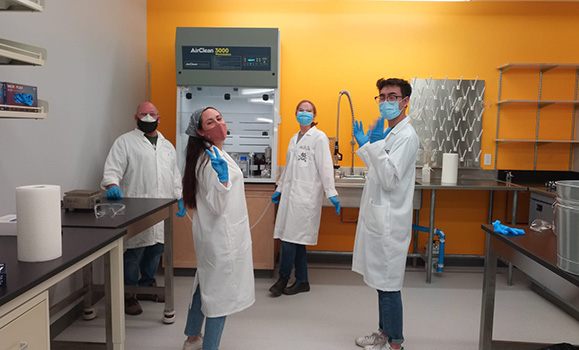
The team of Dal researchers shown in a lab.
The plastics found in the samples were later analyzed to help determine their origins.听
Through back-trajectory modelling and the analysis of the plastics collected, the 黄色直播 researchers believe they were sourced from the Atlantic garbage patch as the hurricane passed over.听Ocean currents transport marine microplastics around the world and often concentrate in ocean gyres where the current patterns become circular, creating massive oceanic garbage patches.听
New area of study
The ocean is home to much of the world's microplastics. They are initially sourced on land and are transported to the ocean by various waterways, wastewater, or the atmosphere. Microplastics are formed in one of two ways: larger plastics and synthetic fibers can degrade over time leaving behind the microplastics or they can be manufactured intentionally for products such as exfoliants.
Atmospheric microplastic research is still a relatively novel field of study compared to contemporary ocean or river-based plastic research, says Ryan.听
鈥淭his is still a relatively new field of research, so it was exciting to be involved in researching something we don鈥檛 know much about as a society," she says.
What we do know is that they can be harmful to living creatures.
"These tiny plastic particles can more easily enter organisms鈥� bodies, through eating, drinking or even breathing, making them a serious risk to humans and wildlife,"听says Ryan.
Recommended reading:听Microplastics found in naturally occurring slime under Arctic ice cap
But the implications of microplastics could be even greater than currently understood, particularly if considering how they travel through the atmosphere.听
鈥淚t is believed microplastic pollution in these other compartments may interfere with the ocean's ability to sequester carbon and mitigate the impacts of climate change,鈥� says Ryan 鈥淲ith so many unknowns about microplastics, we believe that any new information is important in helping us better understand how microplastics behave in all environmental compartments.鈥�
The research team hopes to raise public awareness and inform policymakers of the imminent need to introduce sustainable alternative materials for plastics. They also aim to highlight the importance of new technologies to prevent microplastics from entering the environment in the first place.