

Artificial intelligence seems to be everywhere these days as do debates about its pros and cons.听
A group of 黄色直播 researchers and a provincial policymaker gathered in Halifax this week to weigh in on the technology's growing ubiquity and explore ways in which it is being used across Nova Scotia.
 The public panel, held Tuesday at the Halifax Central Library, offered a 'jargon-free' look at AI, inviting people to bring their own questions, concerns and ideas.
As the town hall discussion unfolded, what emerged was a sentiment leaning more towards excitement about the technology's potential than its possible pitfalls.
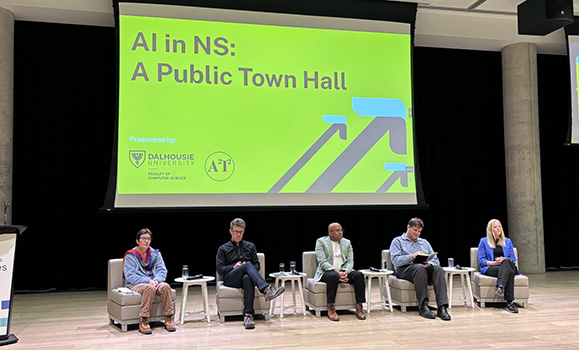
鈥淚 am an optimist. I believe if we educate first and criticize second, we will make the best use of this amazing technology," said Dr. Nur Zincir-Heywood, Distinguished Research Professor and Associate Dean Research in the Faculty of Computer Science (shown left). She noted you cannot be ahead of something and control it if you do not know what it does or how it works.
Here, now, next
One thing was clear from the get-go: AI is no longer the domain of tech experts. Nearly everyone in the room raised a hand when asked by moderator Andrew Cochrane whether they'd used ChatGPT in the past month. 黄色直播 half kept them up when prompted to indicate use multiple times daily.
Of course, AI powers more than chatbots. Attendees at the panel event got a glimpse into some of the 鈥渨eird and wonderful鈥� AI research happening at Dal and how it's being implemented across the province.听
From sensor technologies to detect disease in farm animals to using AI to help people with cerebral palsy better communicate and be understood, there is plenty of good news to balance the concern.
Hype versus reality
Concerns about AI are not trivial, to be sure. Privacy breaches, the spread of misinformation, discrimination, and some (rare) cases of chatbots encouraging users to harm themselves or others are just a few of the technology's drawbacks.
 But many countries, including Canada, have laws designed to protect people from the technology's worst effects. The challenge lies in applying those laws to the people and companies who are developing and using AI.
鈥淭here is a robust system of privacy legislation in the province and in Canada that prevents companies from just dumping your AI data into any old system,鈥� said Dr. Mike Smit, dean in the Faculty of Management (shown right). 鈥淏ut what companies are doing is using the data that they own, or are the custodians of, to train their own internal models.鈥�
The charitable view sees companies using user data to improve the user experience. The cynical version, according to Dr. Smit, is that they are using it to increase profits.
He says large language models like ChatGPT and Microsoft Copilot are the 鈥渇lavour of the month鈥� because they鈥檙e accessible. But he also stresses the cyclical 鈥渂oom and bust鈥� nature of the tech industry, saying there is going to be something new before we know it.
Easing anxiety
One audience member wanted to know if AI was going to replace them at work.
The short answer, according to Nova Scotia's听Deputy Minister of Department of Cyber Security and Digital Solutions, is no.
 鈥淔ind me a job where a person has been fired and been fully replaced with AI,鈥� said Jennifer LaPlante (shown left). 鈥淭he inherent cost associated with deploying these AI solutions and replacing all the little tasks an individual does with an AI system is astronomical.鈥� She said people get 鈥渁nimated鈥� about the potential of AI taking jobs, but what they fail to factor in is the cost of building and maintaining and securing AI solutions.
鈥淎I is the tool you want it to be,鈥� she said. 鈥淵ou can replace tasks with AI, but you cannot replace individuals.鈥�
In the context of the provincial government, she said her department is looking at how to use AI to improve services and make things faster.
The critical thing to remember, said LaPlante, is that AI is just a tool. 鈥淚t鈥檚 not about what AI can do to you, but how you can leverage AI."
Deepfakes for good
One audience member asked about the harm of deep-fake technology or the ability for AI to fabricate audio or video of someone doing or saying something they didn鈥檛 do or say in reality.

Dr. Suresh Neethirajan, Canada Research Chair in Digital Livestock Farming, posited that while many deepfakes are harmful, the technology can also be put to good use.
鈥淭here is a lot of cringey stuff, but it was a human being that used the tool to create it. So, I want to explore: can the same technology be used for good?鈥� he asked.
In an agricultural context, for example, Dr.听Neethirajan (shown right) said baby cows can be soothed by extended-reality versions of their mothers to reduce separation anxiety and distress.
鈥淚t all comes down to the human intention behind the technology that decides how it is being deployed."
Education as a supportive tool
The solution, according to the panel of academics, is education.
 Computer Science Professor Dr. Frank Rudcziz (shown left), director of the Dal-based AtlanticArtificial Intelligence Institute, said ultimately what he wants people to know is pulling away from AI as we see it in the news and learning what it鈥檚 really all about is critical.
It鈥檚 complicated, he acknowledged, but the solution is right here in Halifax.
鈥淏uilding local talent and supporting local ecosystems to going to be the way we survive this phase,鈥� he said. 鈥淚f those two things come together 鈥� investing in an ecosystem and a public that is hungry to learn about the details 鈥� it will be crucial to success and sustainability.鈥�
听