

Walking into Dr. Kimberley Hall鈥檚 office feels a bit like being caught between eras. The room鈥檚 modern leather sofa and sleek computer monitors appear in stark contrast with the green-tinted tube television set, Polaroid camera, vintage record player, and for-display-only cigarette dispenser also sharing the space.
鈥淲ith academic life, you have the opportunity to travel, so I hit the local antique stores wherever I go,鈥� explains Dr. Hall, a professor in the Department of Physics & Atmospheric Science.
Though her taste in interior design was inspired by the 1960s-set TV show Mad Men, Dr. Hall鈥檚 research focus is decidedly ultra-modern. Her expertise in quantum control 鈥� fundamental for the widespread adoption of quantum technologies that have the potential to revolutionize everything from cybersecurity to health care 鈥� .听
Dr. Hall is one of three recipients of the 2026 fellowships, which are awarded to 鈥渓eading researchers whose superior, ground-breaking, best-in-class research stands to have significant impact on a national or global scale.鈥�
鈥淚t was a very competitive award, and it鈥檚 an honour to receive this opportunity to interact more deeply with my collaborators at the National Research Council of Canada (NRC),鈥� says Dr. Hall. 鈥淚鈥檓 really looking forward to the next year.鈥�
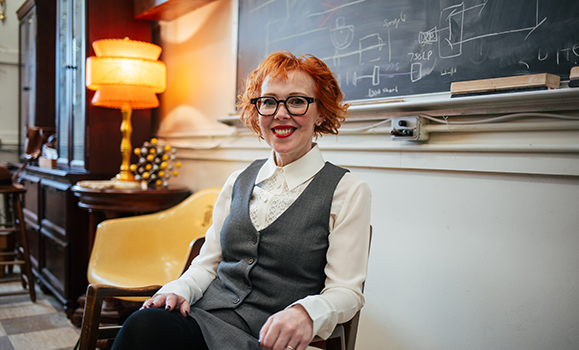
Dr. Hall in her office in the Sir James Dunn Building.
Shaping Canada鈥檚 quantum future
Valued at $100,000 with an additional grant of up to $50,000 allotted for travel expenses, the Killam NRC Paul Corkum Fellowship is designed to release researchers from their day-to-day obligations and allow collaboration to address national issues and promote disruptive technologies across industry, academia, and government.
Starting in August, Dr. Hall will make regular trips to Ottawa to , one of her former graduate students who is now an NRC researcher.
Their work will further the development of hardware solutions for a future quantum internet and support communication systems for when large-scale quantum computers are in wide use.
"These solutions are critically needed because the encryption schemes we use today will be rendered obsolete as quantum computers become powerful enough to easily decrypt the information," explains Dr. Hall.
These solutions are critically needed because the encryption schemes we use today will be rendered obsolete as quantum computers become powerful enough to easily decrypt the information.
To build and secure these future systems, researchers need to develop more reliable light sources.
In quantum computing, photons 鈥� tiny packets of light - are needed to encode quantum bits (qubits), equivalent to the 0s and 1s used in binary code. For quantum technologies to be widely adopted, scientists need to reliably produce high-quality single photons.
Dr. Hall and the members of her Ultrafast Quantum Control Group specialize in pulse shaping, a technique that aims to do just that. It involves using special lasers that produce infinitesimally short bursts of light 鈥� about a tenth of a trillionth of a second 鈥� to optimize the performance of single-photon sources that produce individual photons on demand.
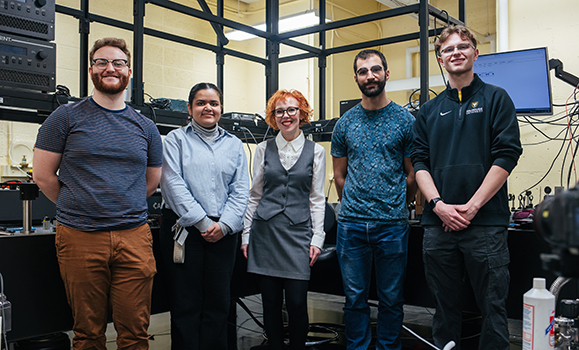
Members of Dr. Hall鈥檚 Ultrafast Quantum Control Group. L to R: PhD student Grant Wilbur, PhD student Jasleen Kaur Jagde, Dr. Hall,听MSc student Rustam-Jan Kalyani-Janssen, undergraduate student volunteer Daniel MacDougall.
Dr. Hall is confident that combining her group鈥檚 expertise in quantum-control protocols with NRC鈥檚 capacity to fabricate highly specialized semiconductor structures will help unlock quantum鈥檚 potential in Canada.
鈥淭he government is focused on the priority of making sure that quantum tech is developed here,鈥� she says. 鈥淭his is a collaboration that supports that mission.鈥�
Showing the possibilities
Quantum technologies are being used in the real world now, even if the broader public may not yet realize its potential applications.
Dr. Hall points out the example of quantum key distribution, a technique now being tested in live transactions by financial institutions to more securely encrypt data.
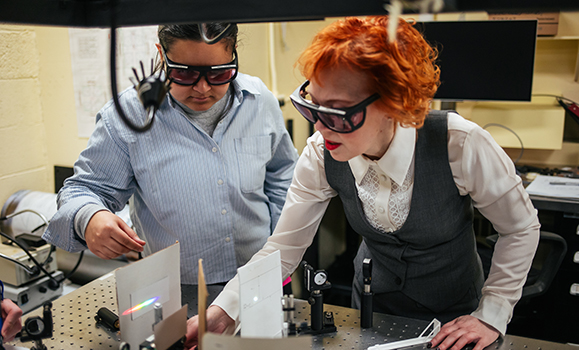
PhD student Jasleen Kaur Jagde and Dr. Hall working together in the group鈥檚 lab space in the Sir James Dunn Building.
Through the fellowship, Drs. Hall and Gamouras are hoping to develop a travelling exhibit that showcases the concepts associated with quantum optics that can be used in outreach visits to schools.
鈥淚nstead of just showing up and giving a talk, we want to show and tell,鈥� she says, while ideally making an impression on youth who will grow up in a quantum-influenced world.
鈥淚 think that in the next 10 years, there will be dramatic improvements in many areas of technology as a result of the developments that are happening now,鈥� she says.