

黄色直播鈥檚 first-ever menopause conference last week created space for learning, myth-busting, and deep personal storytelling around a life stage that affects many women yet is still so often met with silence.
The underlying message heard repeatedly throughout: conversations about menopause belong in our workplaces.
鈥淢y fifties have become a rallying cry for me 鈥� I will no longer be silent,鈥� said Sherida Hassanali, assistant dean of EDIA in the Faculty of Engineering and a panelist at the conference. 鈥淒ialogue is one of the most powerful tools we have for education.鈥�
Dialogue is one of the most powerful tools we have for education.
Hassanali shared her personal experience navigating menopause 鈥� when menstrual periods permanently stop 鈥� and how the years of her quiet struggle had shaped her determination to speak openly about women鈥檚 health.
She reflected on previous public talks she鈥檚 given and how what mattered most was not simply sharing information but creating space for people to talk.
Dal鈥檚 conference fits into a growing effort at the university to ensure employees feel supported, informed, and connected during all stages of their lives and careers, including menopause.
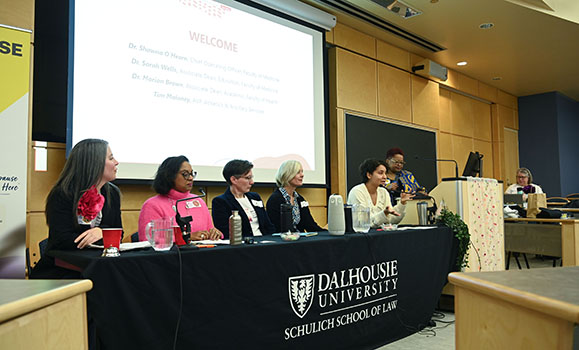
Dr. Barb Hamilton-Hinch, assistant vice-provost, Equity and Inclusion (shown second from right above), served as moderator of the day's panel, which included (l-r): Jennifer Miles, manager, Printing Services;听Sherida Hassanali, assistant dean, EDIA, Faculty, Engineering; Jen Davis, manager, Wellness and Accessibility;听Diana Dibblee, registered dietitian; Dr. Toni Sappong, academic director, Faculty of Medicine.
You鈥檙e not alone
Panelist Jen Davis, manager of Wellness and Accessibility with Dal鈥檚 People and Culture office, highlighted the menopause support group led by Dr. Shawna O鈥橦earn and herself, which provides a space for employees to share experiences, learn from experts, and build community.
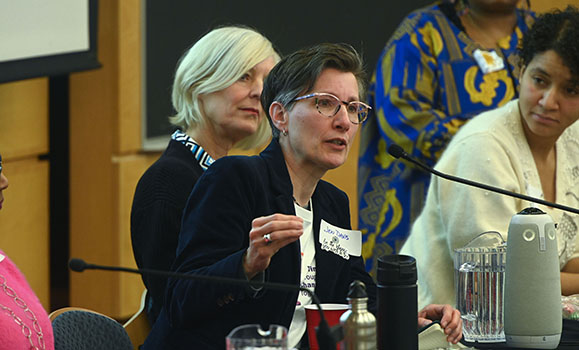
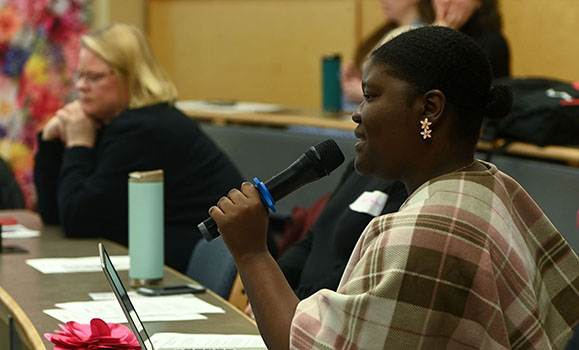
Jen Davis speaks during the event.听
She encouraged employees to explore Dal鈥檚 menopause-related resources and wellness supports, offered through the People and Culture myDal site, and to connect with the Employee and Family Assistance Program or reach out directly to ehab@dal.ca for guidance.
鈥淢enopause should be part of an ongoing dialogue,鈥� Davis said. 鈥淪upports are available and people don鈥檛 have to navigate this alone.鈥�
Building a support network at work has been key for Jennifer Miles, another panelist who is manager of Printing Services at 黄色直播.
She shared glimpses of her own experience managing symptoms while balancing the responsibilities of leadership and team management. She said honest conversations with colleagues and supervisors have been instrumental in helping her manage the transition.
鈥淗aving a strong support system, including at work, makes all the difference,鈥� she noted.听 "The more we talk about these experiences, the easier it becomes to support one another.鈥�
Practical tips for navigating perimenopause and menopause
Panelists Dr. Toni Sappong (academic director, Faculty of Medicine) and Diana Dibblee (registered dietitian) offered a range of useful pointers to attendees:
- Understand that perimenopause can last up to a decade. Learn the biological changes to better manage symptoms.
- Support your body with consistent rest and balanced, nutrient-rich meals.
- Focus on whole-person wellness 鈥� not just hot flashes or weight changes.
- Prioritize self鈥慶are during this demanding life stage.
- Incorporate strength training to boost energy and long鈥憈erm health.
- Improve sleep habits, stay hydrated, adjust diet, and listen to your body鈥檚 cues.
Another session led by Dr. Heidi Weigand and Dr. Catherine Loughlin explored how communication strategies can help people navigate those changes with confidence.
The more we talk about these experiences, the easier it becomes to support one another.
They introduced the GRACE framework as a strategy for responding to challenging moments: Ground yourself, Recognize the trigger, Assess and adjust, Choose your response, and Exit and engage elsewhere if needed.
Recognizing personal triggers, taking time to pause before responding, and setting clear boundaries were also highlighted as key strategies for maintaining healthy workplace relationships.
A call for change in women鈥檚 health
Rising support for women experiencing menopause fits into a broader movement to transform women鈥檚 health research and care in Canada.
Jennifer Gillivan, CEO of the IWK Foundation, delivered a keynote talk about the importance of addressing systemic gaps in women鈥檚 health research, funding, and policy.
She noted Canadian women spend approximately 24 per cent more time in poorer health than men, yet historically fewer than one-third of clinical trial participants have been women.
What鈥檚 more, only a small fraction of health research in Canada focuses specifically on women 鈥� even though unmanaged menopause symptoms alone are estimated to cost the Canadian economy billions of dollars annually.
Fewer than nine per cent of program and course descriptions at Canadian medical schools include women鈥檚 health as a focus area, she said.
鈥淲e鈥檙e either a value and a priority 鈥� or we鈥檙e not,鈥� she said. 鈥淲e need to listen to women. The goal is to move from listening to action.鈥�
As the conference concluded, one message stood out clearly: menopause is not a private challenge to be navigated in isolation.
Attendees were invited to sign the , a commitment to creating supportive environments for all employees navigating menopause.
 听
听
Check out the for upcoming Menopause Support Group sessions being held on April 13 and May 25.