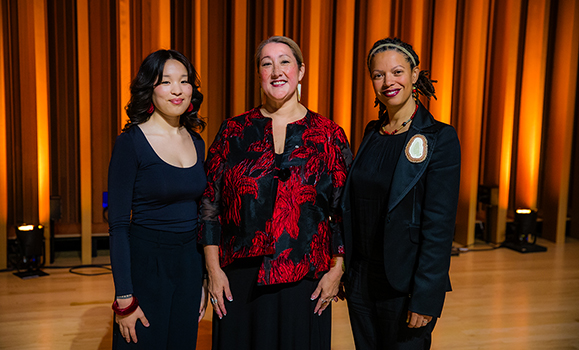

Deantha Edmund’s Artist-In-Residence mentorship at »ÆÉ«Ö±²¥â€™s Fountain School of Performing Arts was guided by a simple but powerful belief: every artist deserves to know they belong.
The Juno award-winning Inuk soprano, composer, and writer understands the importance of representation, being one of the few Indigenous artists working in the world of classical music. Her career has been shaped by a passion for classical singing but also by a commitment to bringing Indigenous stories, perspectives, and languages into spaces where they have often been absent.
“I’m an urban Inuk Irish Newfoundlander who’s allergic to fish and who sings Inuktitut,� says Edmunds. “An Indigenous person in the classical world … there’s not a lot of us.�
An Indigenous person in the classical world … there’s not a lot of us.
The power of being heard
Edmunds was joined on stage at Dal’s Joseph Strug Concert Hall last Saturday (Oct. 24) for a performance with DalChorus and Nunavut-born DalVoice student Princess Kusugak in a program that explored Inuit heritage, identity, and contemporary experience through conversation and song.Ìý
The event was designed to celebrate Inuit culture, language, and storytelling while advancing representation and inclusion in classical music.
“I’ve known Deantha since I was Princess’s age, and this is a beautiful opportunity for us to come back together after all these years,� says Dr. Nicole Jordan, DalChorus director. “It’s a real honour to make space for both Deantha and Princess here as part of my role on the Fountain School’s Equity, Diversity, Inclusivity, and Accessibility (EDIA) Committee.�
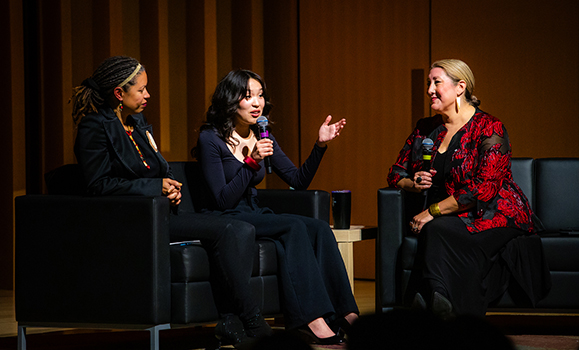
Dr. Nicole Jordan, left, with Kusugak, centre, and Edmunds.
Finding confidence in identity
For Kusugak, a third-year voice student and emerging Inuit vocalist, collaborating with Dr. Jordan and Edmunds was much more than a performance opportunity. It has been a chance for her and fellow students to explore how music can create connections between cultures, deepen personal identity, and open conversations about diverse Inuit experiences and traditions.Ìý
“I’m lucky to have Dr. J because I’ve never felt like I had to hide or feel ashamed of who I am as an Indigenous person,â€� says Kusugak. “I’ve always felt accepted, supported, and that my opinion matters.â€�Ìý
As Music faculty and an EDIA advocate, Dr. Jordan recognizes the importance of ensuring Indigenous students have agency over how their cultures are represented and shared. Ìý“Being expected to perform your culture can be an honour. It’s also a burden,â€� she says. “There can be an emotional cost to doing that.â€�Ìý
I’m figuring out how to balance educating others about my culture while still displaying myself as an individual artist.
Coming to the Fountain School prompted KusugakÌýto reflect on the role identity plays in her creative work and artistic voice. “It’s something I’m trying to learn about myself,â€� she says.. “I’m figuring out how to balance educating others about my culture while still displaying myself as an individual artist.â€�
Reinventing the repertoire: singing in Inuktitut
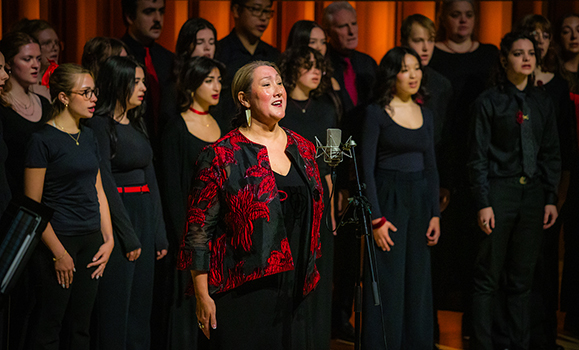
In addition to conversations with Edmunds and Kusugak, led by Dr. Jordan on her “Oprah corner couchesâ€�, the evening’s concert includedÌýa famous piece by Mozart titledÌýAve verum corpus. Edmunds and Kusugak sang it as a duet in Inuttitut (Opinak ikkiliojutit), the Nunatsiavut dialect of Inuktitut, as Edmund’s ancestors did, in church, on the North Coast of Labrador for hundreds of years.Ìý
The Mozart piece, and other classical church music, was brought by German missionaries of the Moravian faith. "In some of that repertoire, my ancestors changed parts of the music, the phrasing, instrumentation, tempo,� says Edmunds. “Changing the artistic style of it is very subtle but shows incredible Inuit agency in the face of colonialism.�
For DalChorus members figuring out a language they’ve never experienced before, the process of rehearsing and singing Edmund’s songÌýLegacyÌýinÌýInuktitut has required patience, humility, and a willingness to learn.
“Having the chance to sing some of Deantha’s work has been a really big learning opportunity,� says Kusugak. “Inuktitut is not an easy language to just pick up.�
Creating pathways forward
Edmunds describes her Artist-in-Residence experience not as a one-way transfer of technical skills from mentor to student, but as a shared process of learning and discovery. She was struck by the student’s openness, curiosity, and willingness to engage deeply with questions about creativity, identity, and artistic practice.
“They’re beginning the real work,� says Edmunds. “Real growth as a singer comes from understanding who you are, embracing your unique voice, and having the courage to share it with others.�
As DalChorus and KusugakÌýprepare for a “bigger singâ€� atÌýtheir Dec. 6 concert, the learning continues, both in the music and in the conversations surrounding it.
If Princess can find her footing musically and vocally, which she is doing here at Dal, in life she will soar.
“I want Princess to know that her voice is important, and her presence matters,� says Edmunds. “If she can find her footing musically and vocally, which she is doing here at Dal, in life she will soar.�